Spoken Language
The Spoken Language Endorsement assesses your ability to present formally, respond to questions, and use Standard English effectively. While it receives a separate Pass, Merit, or Distinction grade rather than numerical marks, the skills you develop here—structuring arguments and maintaining formal register—will directly enhance your performance in the written exam components.
Study Notes
Overview
The GCSE English Language Spoken Language Endorsement is a unique component of your qualification. It is internally assessed by your teacher and externally moderated. Rather than contributing numerically to your final 1-9 grade, it appears on your certificate as a separate endorsement: Pass, Merit, or Distinction.
However, this is not an excuse to take it lightly. The skills required for a Distinction—organising a coherent argument, engaging an audience, responding thoughtfully to unseen questions, and sustaining a formal register—are exactly the same skills that earn top marks in the Writing components of your exam papers.
The Three Assessment Objectives
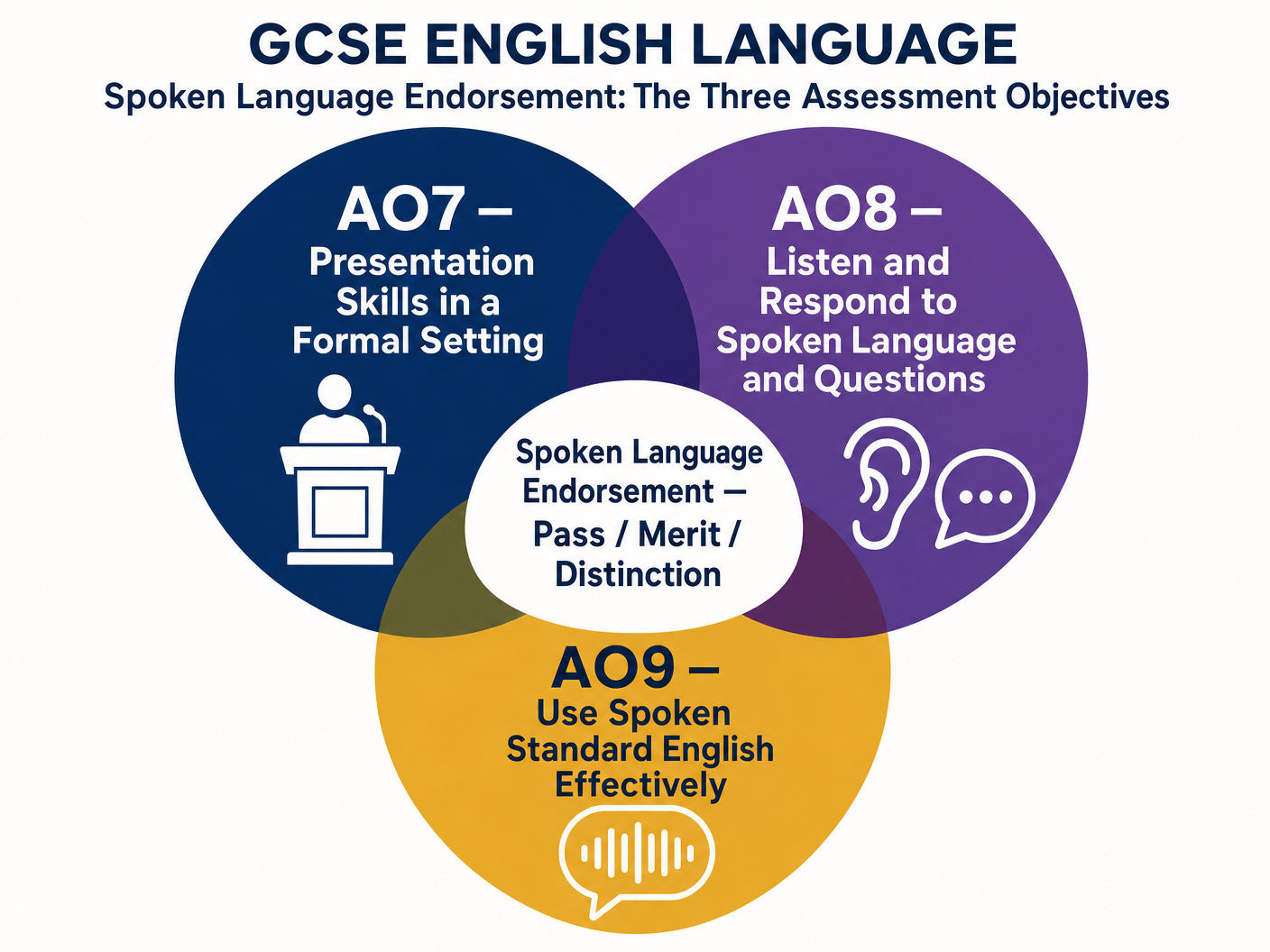
The endorsement is assessed against three specific Assessment Objectives (AOs). Every mark awarded is tied directly to these criteria.
AO7: Demonstrate presentation skills in a formal setting
This objective focuses on how you deliver your prepared material. Examiners (your teachers) are looking for:
- Structure: A clear beginning, middle, and end.
- Engagement: Maintaining eye contact, varying your pace and tone, and using rhetorical devices to keep the audience interested.
- Confidence: Delivering your points with authority rather than reading directly from a script.
AO8: Listen and respond appropriately to spoken language, including to questions and feedback
This objective is often where candidates lose potential Merit or Distinction grades. After your presentation, you will face a Q&A session. Examiners reward candidates who:
- Listen actively: Processing the full question before speaking.
- Respond relevantly: Answering the actual question asked, not the one you hoped they would ask.
- Develop responses: Providing thoughtful, detailed answers rather than single-word replies.
AO9: Use spoken Standard English effectively in speeches and presentations
Standard English refers to the grammar and vocabulary used in formal contexts.
- What it is: Using correct grammatical structures (e.g., "we were" instead of "we was") and formal vocabulary.
- What it is NOT: It is not about your accent. You can speak in a strong regional accent and still use perfect Standard English.
Structuring Your Presentation
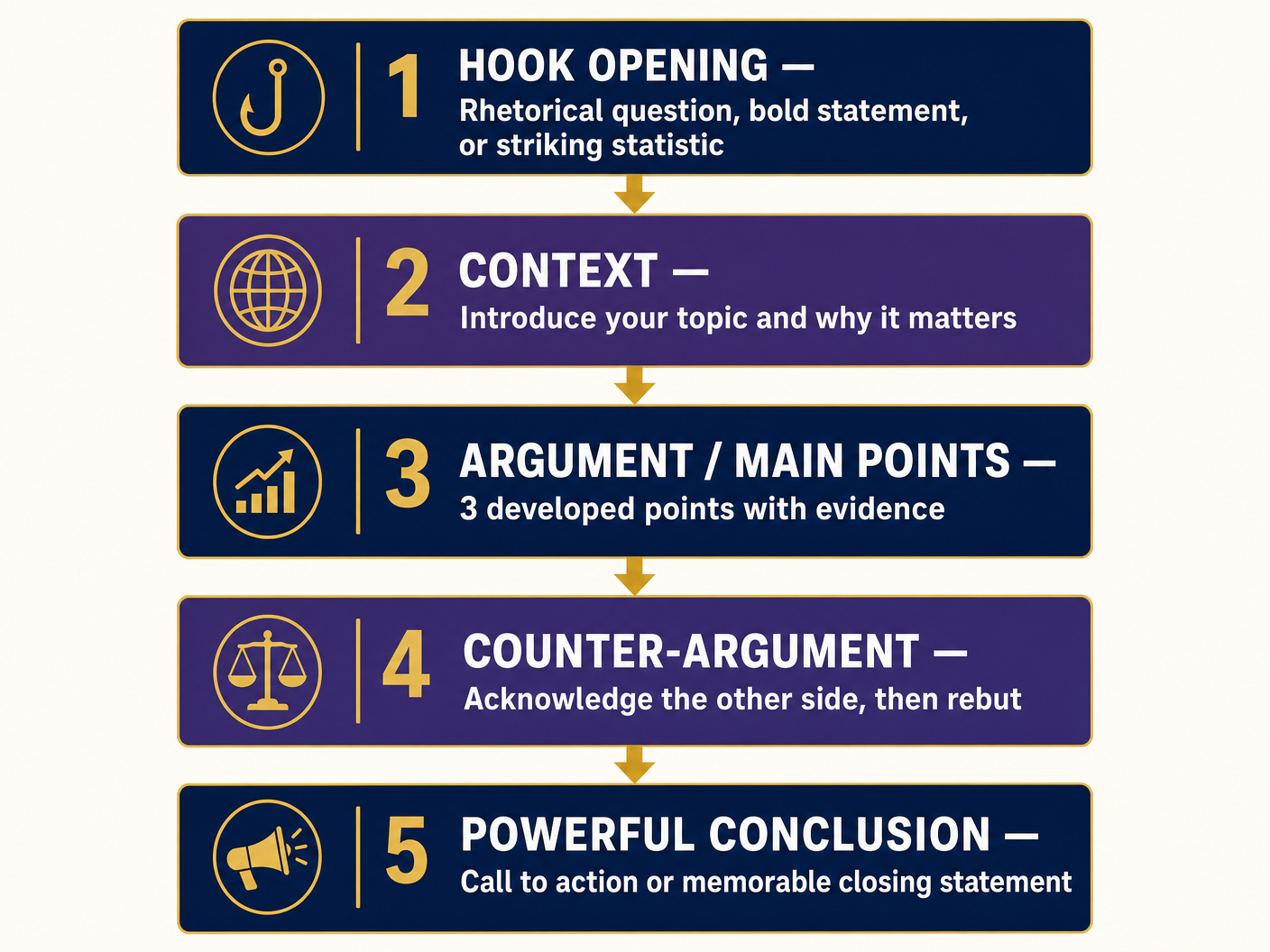
A successful presentation needs a clear, logical structure that guides the listener through your argument.
- The Hook: Start with a rhetorical question, a striking statistic, or a bold statement to grab attention immediately.
- The Context: Briefly explain your topic and why it matters to your audience.
- The Argument: Develop three main points, supporting each with evidence, anecdotes, or logical reasoning.
- The Counter-Argument: Acknowledge the opposing viewpoint and systematically rebut it. This demonstrates intellectual maturity and pushes you towards Merit/Distinction.
- The Conclusion: End with a powerful call to action or a memorable closing statement.
Grade Descriptors
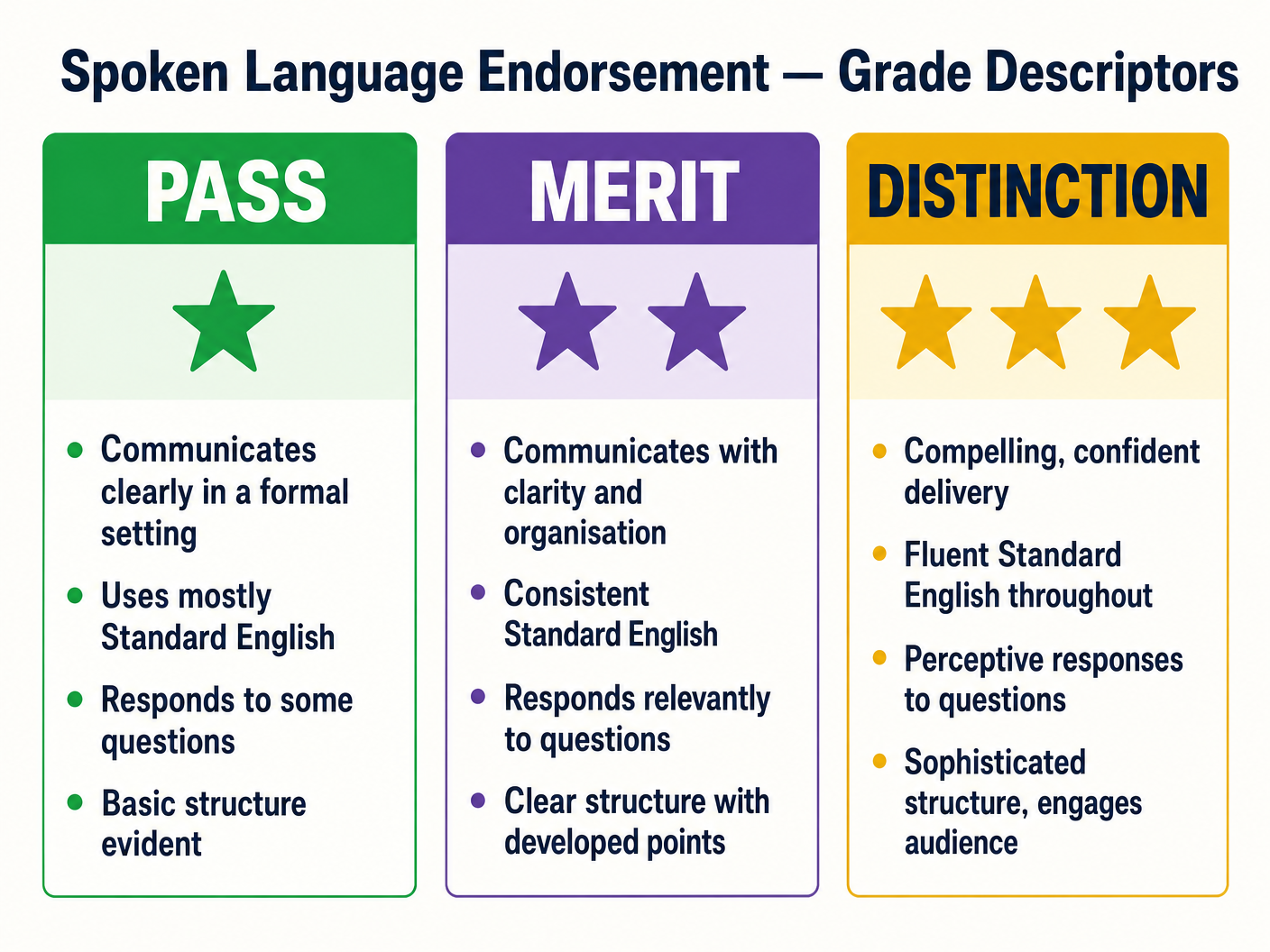
Understanding what separates a Pass from a Distinction is crucial for your preparation.
- Pass: Communicates clearly, uses mostly Standard English, responds to some questions, and has a basic structure.
- Merit: Communicates with clarity and organisation, uses consistent Standard English, responds relevantly to questions, and has a clear structure with developed points.
- Distinction: Delivers compellingly and confidently, uses fluent Standard English throughout, provides perceptive responses to questions, and uses a sophisticated structure that genuinely engages the audience.
Listen to the Podcast
For a deep dive into the Spoken Language Endorsement, including an examiner's perspective on the most common mistakes candidates make, listen to our dedicated 10-minute revision podcast:
Visual Resources
3 diagrams and illustrations
Interactive Diagrams
2 interactive diagrams to visualise key concepts
Conceptual Flow Outline
Preparation workflow for the Spoken Language Endorsement
Conceptual Flow Outline
Effective Q&A Response Strategy (AO8)
Worked Examples
3 detailed examples with solutions and examiner commentary
Practice Questions
Test your understanding — click to reveal model answers
Draft the opening 'Hook' for a presentation arguing that school uniform should be abolished.
Hint: Think about using a rhetorical question or a surprising fact to grab the audience's attention immediately.
Identify the non-standard English in this sentence and rewrite it formally: 'When we was looking at the data, we seen that loads of people agree.'
Hint: Look for incorrect verb agreements and informal vocabulary.
Write a counter-argument paragraph for a presentation arguing that social media is harmful to teenagers.
Hint: Acknowledge the opposing view (that social media has benefits), then politely but firmly rebut it with your own evidence.
How would you respond to this Q&A question if you didn't know the exact answer: 'What percentage of the UK budget is spent on the NHS compared to education?'
Hint: Honesty is key. Admit you don't know the exact figure, but offer related knowledge.
Explain how the skills used in the Spoken Language Endorsement support AO5 and AO6 in the written exams.
Hint: Think about how structuring a speech relates to structuring an essay, and how Standard English relates to SPaG.